Posts

Showing posts with the label World History

HIstory of the Christmas Tree

Image
Long before the advent of Christianity, plants and trees that remained green all year had a special meaning for people in the winter. Just as people today decorate their homes during the festive season with pine, spruce, and fir trees, ancient peoples hung evergreen boughs over their doors and windows. In many countries it was believed that evergreens would keep away witches, ghosts, evil spirits, and illness. In the Northern hemisphere, the shortest day and longest night of the year falls on December 21 or December 22 and is called the winter solstice. Many ancient people believed that the sun was a god and that winter came every year because the sun god had become sick and weak. They celebrated the solstice because it meant that at last the sun god would begin to get well. Evergreen boughs reminded them of all the green plants that would grow again when the sun god was strong and summer would return. During the Roman festival of Saturnalia, celebrants often decorated their ...
Weekend of the Witch: Fame

Image
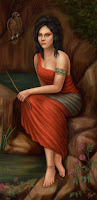
Famous Witches: The Immortal Witch Circe is one of the best-known mythological mistresses of mayhem. According to the Odyssey, Odysseus and his Achaeans found themselves fleeing the land of the Laestrygonians. After a bunch of Odysseus’ scouts were captured and eaten by the Laestrygonian king, and nearly all of his ships sunk by large boulders, the Achaeans ended up on the shore of Aeaea, home to the witch-goddess Circe. Circe is well known for her magical mojo, and had quite the reputation for her knowledge of plants and potions. She may have been the daughter of Helios, the sun god or a daughter of Hecate, the Goddess of Magic and Witchcraft. When Odysseus visited Aeaea, Circe turned his men into swine, but Odysseus was given a magical plant by the gods that prevented Circe from morphing him. After making Circe swear not to betray him, Odysseus and his men lived under Circe’s protection for a year before attempting to sail back to Ithaca. Morgan le Fay , whose na...

Weekend of the Witch: History

Image
Witches and wizards are people thought to possess magical powers or to command  supernatural  forces. They appear in the myths and folktales of many cultures. The word  witch  usually refers to a female, though male witches exist in some traditions. Men who possess the powers associated with witchcraft are often known as wizards. Witches are, for the most part, humans who gained arcane power either through birthright or, more commonly, by making a pact with some sort of spirit.  They often have a familiar animal or spirit. Are They Bad or Good?   In many myths and legends, witches are evil, dishonest, or dangerous. Some cultures do not consider them fully human. If not evil by nature, witches may be possessed by demons or wicked spirits determined to harm humans according to the religious teaching.  Yet ordinary men and women may learn magic for the purpose of hurting others. Such people are sometimes called sorcerers and sorceresses rather...

Forces of Darkness: Demons

Image
Demons are a race of magical beings motivated by Evil. They seek out to kill innocents and the forces of Good. Devils are generally regarded as the adversaries of the gods, while the image of demons ranges from mischief makers to powerful destructive forces. In many religions, devils and demons stand on the opposite side of the cosmic balance from gods and angels. Although devils and demons have been pictured in many different ways, they are usually associated with darkness, danger, violence, and death. Demons are unable to feel emotions and possess no soul or conscience. Almost all demons are immortal, and in some occasions, however, a demon can become good and desire to live a mortal life. Most demons live in the Hell, Underworld, the mortal world or other plane of existence, depending on what goal they wish to achieve or how they influence the mortal world. When exiled, a demon is not allowed to live in or enter the Underworld which is punishable by death. In most mytholog...

Solar Fight; Ra vs Apep

Image
Apophis (Apep)was the Great Serpent Lord of Chaos and Destruction and the enemy of Ra, God of the Sun and Lord of Order. Ra and Apophis were sworn enemies and battled each night, and of course, with the help of Set, Ra won every time. The dynamic between the two are that of pure opposites. Their existence opposes each other, and they do nothing but fight. Each night, the two would battle but Ra was usually victorious. When Apophis did win, there would be an eclipse or a Storm that blocked the sun which was seen as Apophis eating the sun and when the eclipse ended, it would mark Ra's escape. Often, Ra was depicted with other gods protecting and aiding him from Apophis. Because Apep is so terrible (always described as fathomless huge, which is why it is depicted with such tightly-packed coils to represent how much of it there is, and sometimes said to have a head made of vicious hard flint or eyes of gold) and so dangerous, the sun god was understood to not be able to fight such ...

Spring Growth

Image
Spring begins with the first green shoots and explodes into a multitude of beautiful blossoms and promise of good harvest. Winter’s hardship and last year’s conservatism votes in West end with green progressivism with Dutch and hopeful the French.  Back to the story In ancient times many festivals were held to celebrate the Gods and Goddesses of Spring and Nature who were associated with flowering, growth and fertility of the land and people. Now below are the many faces of the springtime deity taken from myths from around the world. Gods and Goddesses of Springtime Eostre is the Germanic Goddess of Spring, Growth and Dawn. Persephone is the Greek Goddess of Springtime and Flowers, Queen of the Underworld, Roman form as Proserpina. Aristaeus is one of the most beneficent hero-gods of ancient Greece. He taught many useful agricultural practices  Zephyr aka Zephyrus (Favonius) is the Greek God of Wind of the West and spring.  Horae: Goddesses of th...

World AID Day: Myth Buster

Image
Human immunodeficiency virus (HIV) is a virus that attacks the immune system. HIV can cause acquired immune deficiency syndrome (AIDS), a disease that severely weakens immunity and can be fatal. One person passes HIV to another under certain circumstances. Understanding the facts rather than buying into lingering myths about transmission can prevent misinformation — and HIV —from spreading. There is still no cure or vaccine for  HIV/AIDS , which affects  approximately 37 million people  around the world. But there is reason to hope that the global response to this pandemic is improving.  Fewer people died of HIV in 2015 than at any point in almost 20 years, while new HIV infections are at the lowest point since 1991, the  World Health Organization noted in its 2016 progress report . That may be, in part, because at least  two million new people began taking antiretroviral therapy  in 2015, the largest annual increase ever in the history of the ...

Dog Days of Summer

Image
The Dog Days are traditionally the 40 days leading up to the heliacal rising of Sirius, being the period of  3 rd  July to 11 th  August.   These are considered to be the hottest days of the summer – especially in the regions around the Mediterranean Sea, where Sirius has long had a major role in mythology, religion and agriculture.  For the Egyptians the rising of Sirius was essential, marking the inundation of the Nile and the start of a new year.  Sirius, which was also known as Sothis, was closely linked to the Egyptian Mother goddess Isis (Aset) and Osiris, Ruler of the Underworld.  Osiris: God King of the Underworld  Sirius has been known since ancient times, and its name signified its nature as “scorching” or “sparkling.” It was associated with the Egyptian god Osiris and other gods. Ancient Egyptians noted that Sirius rose just before the sun each year immediately prior to the annual flooding of the Nile River. Although...

PTSD: A Problem since the Invention of War

Image
PTSD Post Traumatic stress disorder (PTSD) can be defined as an emotional illness rooting from anxiety that happens when a person was exposed to a scary, dangerous, and even life threatening event. The diagnosis may be given when a group of symptoms, such as disturbing recurring flashbacks, avoidance or numbing of memories of the event, and hyperarousal, continue for more than a month after the occurrence of a traumatic event. More than 5 million Americans are affected by post traumatic stress disorder (PTSD) each year. The history of post traumatic stress disorder was not well documented until it was appropriately defined in modern times. From Ancient Times Post traumatic stress disorder has existed as long as there has been trauma. Although PTSD is not limited to war experience, it was battle that brought it to public attention. PTSD has been documented for having going on for thousands of years, although went through history being called different names. During early war...