Posts

Showing posts with the label Greek Myth

Rest in the Field of Elysium

Image
Elysian, a word from Greek Mythology relating to Elysium, meaning:  Blissful, blessed, celestial, heavenly, ethereal. It is an adjective describing something peaceful and perfect, something divinely inspired something beautifully creative.  “Being of such surpassing excellence as to suggest inspiration by the gods” Elysium is the place of paradise for the heroic and the virtuous. The souls of those who had either died a hero's death or led a virtuous life will live in peace in Elysium forever. Elysium seemed to be the only happy part of the Underworld, and beyond its gates, one could see neighborhoods of beautiful houses from every time-period in history. Originally only heroes whom the gods had made immortal went to Elysium. Eventually, it became the destination of anyone who had lived a righteous life. Chosen by the gods, the souls of mortals and demigods who have been good, righteous, and/or heroic, would remain after death to live a blessed and happy eternal death,...

Happy Earth Day

Image
Mother Nature (sometimes known as Mother Earth or the Earth-Mother) is a common personification of nature that focuses on the life-giving and nurturing aspects of nature by embodying it, in the form of the mother. Ki is an earth goddess in Sumerian mythology Ninhursag was a mother goddess of the mountains, and one of the seven great deities of Sumer. She is principally a fertility goddess. Temple hymn sources identify her as the 'true and great lady of heaven' (possibly in relation to her standing on the mountain) and kings of Sumer were 'nourished by Ninhursag's milk'. Gaia "the Deep-Breasted One” is the ancient Greek Goddess of the earth; some said she was born directly from Khaos with Eros (Love) and Nyx (Night). She is credited with creating the universe, and is known as the mother of many including: Ouranos, the starry sky; Pontos, the sea; the mountains; the twelve Titans and Titanesses; the three Cyclopes, who had but one eye each; the three H...

Psychopomp: Greek Edition III

Image
Thanatos God of Death Lieutenant of Hades Chief Reaper of Souls Death beats equally at the poor man's gate and at the palaces of kings. Thanatos is the God of Peaceful Death. He is the son of Nyx and the twin brother of Hypnos. His Roman counterpart is Letus (Mors). Thanatos was called the god of peaceful death while the Keres were his antithesis as the spirits of violent death. His coming was marked by pain and grief. Thanatos was the son of the primordial gods Erebus (God of Darkness) and Nyx (the dark Goddess of Night) and the brother of the many of the dark gods of death, night, pain and other miseries of humanity. Once he was tricked by Sisyphus which was one of the reasons why the mortal was condemned to the Fields of Punishment. When Thanatos came to take Sisyphus to the Underworld, the cunning man chained up the god, and shoved him under his bed, effectively stopping death until Ares freed him. No matter what you think of death, Thanatos was a noble god ...

Psychopomp: Greek Edition II

Image
Hermes Guide of the Dead Messenger of the Gods God of Travelers and Thieves Hermes is the Greek god of roads, speed, messengers, commerce, travel, thieves, merchants, athletes, and mail deliverers. His Roman counterpart is Mercury. His symbol is the Caduceus. Hermes is the son of Zeus and Maia, daughter of the Titan Atlas, and was born in a cave on mount Cyllene in Arcadia. He is the fastest of the gods, and his position is as the Messenger to Zeus and all the other gods. He is also the Divine Herald, the solemn guide who knew the road to hell and would lead the souls of the dead down to the Underworld, after Thanatos (God of Death) did his job. That's why he was also called Psychopompus, a name given to him for being the guide of souls to the Underworld. Hermes is also the Greek god of Commerce and the Market, and thus the patron of traders, merchants and thieves. His distinguishing qualities were cunning, ingenuity, knowledge and creativity. His realm includ...

Psychopomp: Greek Edition I

Image
Charon: The Ferryman Charon, son of Nyx, was the ferryman of Hades, who carries the souls of the newly deceased across the River Styx that divided the world of the living from the dead. A coin to pay Charon for passage, usually an obolus or drachma, was sometimes placed in or on the mouth of a dead person. The people who didn't receive a proper burial and thus had no obolus were left to wander on the shores of the river Acheron for one hundred years. That's why for the ancient Greeks it was so important to give a respectable burial to the deceased. In some places, it is require by law to properly bury the dead for protection for the citizens and honor gods especially Hades. For instance, Antigone risked her life by burying her brother, Polyneces, because he was considered a traitor and the king of Thebes forbid everyone to bury him. Plato tells us that the souls of the deceased were judged and then, according to their sins, they were taken by Charon to different a...

Gods of Love and Desire: Eros

Image
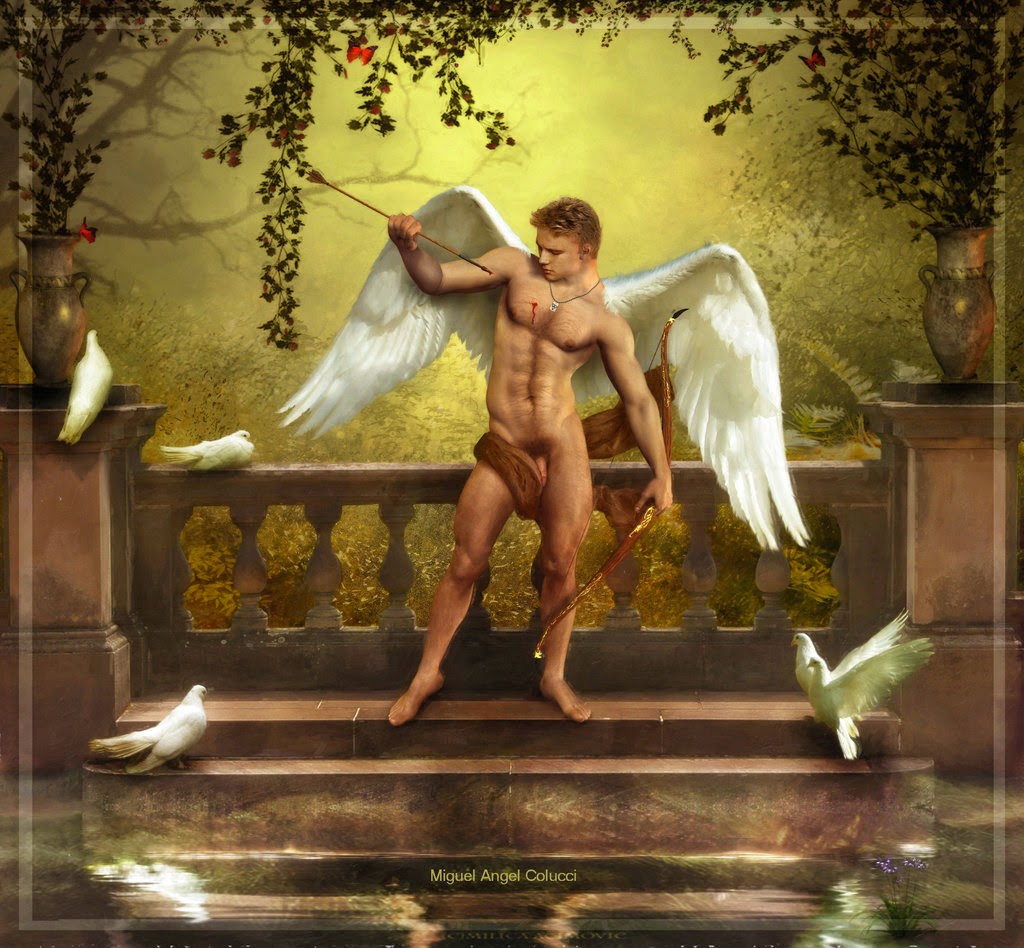
Love is in the air and so is broken heart. Eros was the Greek God of Love, or more precisely, passionate and primal sexual desire. Without warning he selects his targets and forcefully strikes at their hearts, bringing confusion and irrepressible feelings or in the words of Hesiod “ he loosens the limbs and weakens the mind” . In fact, the word erotic comes from his name. Eros himself is a carefree and beautiful youth. Personally I think he is one of the most powerful gods in existence. He makes most gods (favorite target is Zeus) fall in love/lust with other gods and/or mortals regardless of gender.  It was thought that Eros’ arrows, often randomly aimed, made people fall in love. One of the most famous tells involving this was when Apollo ridiculed the skills of Eros as an archer. Apparently Apollo forget he was talking to the son of Aphrodite and ARES. As payback for the remark Eros fired one of his arrows at Apollo, making him fall in love with the nymph Daphne and curs...

Creation Story: Greek Version part II

Image
The First Titanomachy Hades was very skilled in navigating under the earth, was able to lead them all into Tartarus (through a network of Underworld tunnels). There, imprisoned in the maximum-security zone, surrounded by huge bronze walls, and a lava moat, guarded fierce demons, were the Elder Cyclopes and Hekatonkheires. Their guardian, Kampê, was the most ferocious and fearsome monster in all of Tartarus, and even Poseidon, Hades, and Zeus initially shuddered with horror when they saw the infernal monster for the first time. However, the gods overcame their fear, and were able to sneak in. Zeus managed to talk to the Cyclopes Brontes, and convinced him to forge powerful weapons for him and his siblings behind Kampê's back. The three Elder Cyclopes forged three incredibly powerful weapons: the Master Bolt (for Zeus), the Trident (for Poseidon), and the Helm of Darkness (for Hades). With these new weapons, Zeus destroyed Kampê, and Poseidon shattered the chains of the Elder Cy...

Creation Story: Greek version part I

Image
Chaos was the beginning, the emptiness or nothingness from whence everything came. Now Chaos was a gloomy, soupy mist with all the matter in the cosmos just drifting around. Eventually a creator some named her Ananke, Goddess of Necessity, or God collected some of its matter and solidified into the earth, which developed a living personality. She called herself Gaea, the Earth Mother. After a period of time, the sky formed - a protective dome that was blue in the daytime and black at night, and named him Ouranos. Soon Chaos 'got a little creation-happy'. Water collected out of the mist of Chaos, pooled in the deepest parts of the earth and formed the first seas, which developed a consciousness - the god Pontus. Soon another dome came into being beneath the earth, but it was dark and murky, this was Tartarus, the Pit of Evil and Damnation. Then emerge the dark immortals: Nyx, Goddess of the Night and Erebus, God of Darkness and Mist. Erebus and Nyx wed and bore Hemera, Goddes...