Posts

Showing posts with the label Celtic mythology

Beltane: Marriage of the God and Goddess

Image
Many Wiccans and Pagans celebrate Beltane.  It is one of eight solar Sabbats.  This holiday incorporates traditions from the Gaelic Bealtaine, such as the bonfire, but it bears more relation to the Germanic May Day festival, both in its significance (focusing on fertility) and its rituals (such as May pole dancing).  Some traditions celebrate this holiday on May 1 or May Day, whiles others begin their celebration the eve before or April 30th. Beltane has long been celebrated with feasts and rituals. The name means fire of Bel; Belenus being one name for the Sun God, whose coronation feast we now celebrate. As summer begins, weather becomes warmer, and the green earth blossoms, an exuberant mood prevails. In old Celtic traditions it was a time of unabashed sexuality and promiscuity where marriages of a year and a day could be undertaken but it is rarely observed in that manner in modern times (mostly). In the old Celtic times, young people would spend the entire nig...

Gods of the Emerald Isle

Image
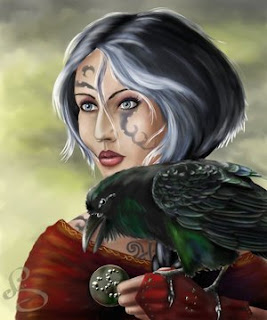
Since it is St. Patrick's Day, I think it is time to remind the gods of old. Morrigan - goddess of war Morrigan is known as the goddess of war, with her name loosely interpreted to mean “Great Queen,” “Phantom Queen” or “Queen of Demons.” She was believed to hover over a battlefield in the form of either a crow or a raven, and supposedly influenced or predicted the outcome of the battle. She appeared to Dagda on the feast of Samhain, had sex with him, and promised to aid him in the upcoming battle. With her aid, Dagda was victorious in his battle. Aonghus - God of love and youth Aonghus, also known as Angus, Aengus, or Oengus of the Bruig, is believed to be the god of love and youth. He is associated with the valley of the River Boyne. His story is that he searched all of Ireland for a beautiful maiden. Aonghus eventually found Caer, who was with 150 other maidens destined to turn into swans on November 1, the feast of Samhain. Aonghus transformed himself into a...

The Price of the Deal

Image
There is always someone looking for the easy way of obtaining more pleasure, wealth or power. I always find it fascinating the lengths some will try just to achieve what they desire most. So some turn to making a deal to the devil. A deal with the devil, compact or pact with the devil is a cultural motif, best exemplified by the legend of Faust and the figure of Mephistopheles, but elemental to many Christian folktales. You know how it works. Want to be a millionaire, Take over the World, gain infinite power, or just to get back at that obnoxious Jerk? Well travel down to those crossroads and the demon will guarantee your wildest dreams, if you just sign on the dotted line with your own blood. This trope is Older than Steam, and does not even require the Abrahamic Devil; any trickster, demon, or evil deity roughly equivalent to Satan can be used. According to traditional Christian belief about witchcraft, the pact is between a person and Satan or a lesser demon. The person offers...

Happy Earth Day

Image
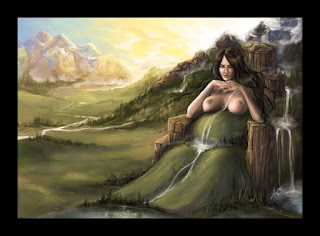
Mother Nature (sometimes known as Mother Earth or the Earth-Mother) is a common personification of nature that focuses on the life-giving and nurturing aspects of nature by embodying it, in the form of the mother. Ki is an earth goddess in Sumerian mythology Ninhursag was a mother goddess of the mountains, and one of the seven great deities of Sumer. She is principally a fertility goddess. Temple hymn sources identify her as the 'true and great lady of heaven' (possibly in relation to her standing on the mountain) and kings of Sumer were 'nourished by Ninhursag's milk'. Gaia "the Deep-Breasted One” is the ancient Greek Goddess of the earth; some said she was born directly from Khaos with Eros (Love) and Nyx (Night). She is credited with creating the universe, and is known as the mother of many including: Ouranos, the starry sky; Pontos, the sea; the mountains; the twelve Titans and Titanesses; the three Cyclopes, who had but one eye each; the three H...

Happy Patrick's Day

Image
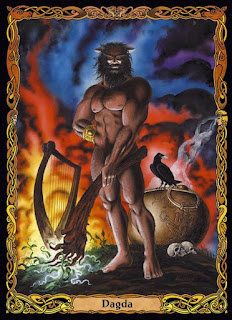
Some of the Popular Myths and Legends of Ireland The Harp of the Dagda This story concerns the most ancient Irish Celtic gods, the first generation of the Tuatha Dé Danaan who had to fight off the giant races of the Firbolgs and the Formorians. Their history is found in the  Lebor Gabála , ‘The Book of Invasions’. When the fairy race of the Tuatha Dé Danann arrived in Ireland, they came like a mist across the waters, bringing with them magical gifts. These were the  Lia fail  – the coronation stone, the spear of Lugh, the sword of Nuada, and the great cauldron of the Dagda, which was said to be able to restore life. The Dagda himself was known as the Good God and he was chief of the gods at this time. Besides his cauldron, he had a harp which was battle-scarred and made of oak. It was covered in rich decorations including a double-headed fish which ran up and down the curved pillar and had jewels for its eyes. Although he had a harper, Uaithne, he cou...

Roll call of the War Gods

Image
War and strife have never been far from human society. For the ancients, war was a way of life, and its varied expressions and nuances determined a host of patron deities. There’s a misconception among many that functions of gods and goddesses were attributed to a single aspect or purpose. It is true that Gods and Goddesses were known for specific roles that involved their skills, but what's blown out of proportion are stories about a single purpose deity not connecting with other aspects of warfare. Gods and Goddesses have been associated with a specific order for their expertise at a particular craft. This article showcases a list of some of the most powerful Gods and Goddesses of war from world mythology. I invoke these gods to combat Trump's presidency in near future and protect the average citizens from his regime of madness. Athena is the Greek Goddess of Wisdom and Warfare. Her warfare was the tactical warfare that calculated each move carefully with strategic st...

The Guide of the Afterlife

Image
Psychopomps Psychopomps (from the Greek word psuchopompos, literally meaning the "guide of souls") are creatures, spirits, angels, or deities in many religions whose responsibility is to escort newly deceased souls from Earth to the afterlife. Their role is not to judge the deceased, but simply to provide safe passage. Appearing frequently on funerary art, psychopomps have been depicted at different times and in different cultures. Anubis is the jackal-headed god of ancient Egypt, who presides over the purification and mummification of the body and is well known for his role as a psychopomp. At the time of death he leads the ba (the aspect of a person that is activated in non-ordinary states, such as sleep and death) to the entrance to the underworld, where the ba undergoes its own purifying journey. After this, Anubis reunites the person’s ba with their core self (or heart) and then leads the deceased to the Hall of Maat where the scales of judgment weigh the heart...

Bring in the Season of New Life with Cernunnos

Image
At the dawn of prehistory, it is said, humanity worshiped a Goddess who often co-existed with a male Deity, sometimes depicted with horns. Such figures represent humanity's elemental search for survival and meaning in mortality, a relentless quest for unity with the divine and the interdependent nature of the existential web. Cernunnos is a horned god found in Celtic mythology. He is connected with male animals, particularly the stag in rut, and this has led him to be associated with fertility and vegetation. Depictions of Cernunnos are found in many parts of the British Isles and Western Europe. He is often portrayed with a beard and wild, shaggy hair -- he is, after all, the lord of the forest. With his mighty antlers, Cernunnos is a protector of the forest and master of the hunt. He is a god of vegetation and trees in his aspect as the Green Man, and a god of lust and fertility when connected with Pan, the Greek satyr God of the Wild. In some traditions, he is seen as a god...