Posts

Showing posts with the label Greek gods

Message from Aeolus and Weather Channel
Image
Message from Aeolus and Weather Channel Aeolus: Lord of the Winds April, May and June are the peak months for tornadoes in the United States. Intense tornadoes are more likely to occur during the spring. Many of the worst tornado outbreaks have struck in April or May. April kicks off what is typically the most active and dangerous three-month period of the year for tornadoes in the United States. During the 20 years from 1997 to 2016, the U.S. averaged 1,225 tornadoes annually, 55 percent of which were sandwiched between April and June. Historically, May has seen the most tornadoes each year with an average of 275. This is followed by June and April, which average 215 and 187 tornadoes per year, respectively. Eight of the 10 worst U.S. tornado outbreaks have occurred in April or May, mostly due to the fact that upper echelon tornado intensities are more likely in those months. In addition, nine of the 10 worst individual tornadoes were spawned during April, May or J...

Roll call of the War Gods

Image
War and strife have never been far from human society. For the ancients, war was a way of life, and its varied expressions and nuances determined a host of patron deities. There’s a misconception among many that functions of gods and goddesses were attributed to a single aspect or purpose. It is true that Gods and Goddesses were known for specific roles that involved their skills, but what's blown out of proportion are stories about a single purpose deity not connecting with other aspects of warfare. Gods and Goddesses have been associated with a specific order for their expertise at a particular craft. This article showcases a list of some of the most powerful Gods and Goddesses of war from world mythology. I invoke these gods to combat Trump's presidency in near future and protect the average citizens from his regime of madness. Athena is the Greek Goddess of Wisdom and Warfare. Her warfare was the tactical warfare that calculated each move carefully with strategic st...

Psychopomp: Greek Edition III

Image
Thanatos God of Death Lieutenant of Hades Chief Reaper of Souls Death beats equally at the poor man's gate and at the palaces of kings. Thanatos is the God of Peaceful Death. He is the son of Nyx and the twin brother of Hypnos. His Roman counterpart is Letus (Mors). Thanatos was called the god of peaceful death while the Keres were his antithesis as the spirits of violent death. His coming was marked by pain and grief. Thanatos was the son of the primordial gods Erebus (God of Darkness) and Nyx (the dark Goddess of Night) and the brother of the many of the dark gods of death, night, pain and other miseries of humanity. Once he was tricked by Sisyphus which was one of the reasons why the mortal was condemned to the Fields of Punishment. When Thanatos came to take Sisyphus to the Underworld, the cunning man chained up the god, and shoved him under his bed, effectively stopping death until Ares freed him. No matter what you think of death, Thanatos was a noble god ...

Psychopomp: Greek Edition II

Image
Hermes Guide of the Dead Messenger of the Gods God of Travelers and Thieves Hermes is the Greek god of roads, speed, messengers, commerce, travel, thieves, merchants, athletes, and mail deliverers. His Roman counterpart is Mercury. His symbol is the Caduceus. Hermes is the son of Zeus and Maia, daughter of the Titan Atlas, and was born in a cave on mount Cyllene in Arcadia. He is the fastest of the gods, and his position is as the Messenger to Zeus and all the other gods. He is also the Divine Herald, the solemn guide who knew the road to hell and would lead the souls of the dead down to the Underworld, after Thanatos (God of Death) did his job. That's why he was also called Psychopompus, a name given to him for being the guide of souls to the Underworld. Hermes is also the Greek god of Commerce and the Market, and thus the patron of traders, merchants and thieves. His distinguishing qualities were cunning, ingenuity, knowledge and creativity. His realm includ...

Psychopomp: Greek Edition I

Image
Charon: The Ferryman Charon, son of Nyx, was the ferryman of Hades, who carries the souls of the newly deceased across the River Styx that divided the world of the living from the dead. A coin to pay Charon for passage, usually an obolus or drachma, was sometimes placed in or on the mouth of a dead person. The people who didn't receive a proper burial and thus had no obolus were left to wander on the shores of the river Acheron for one hundred years. That's why for the ancient Greeks it was so important to give a respectable burial to the deceased. In some places, it is require by law to properly bury the dead for protection for the citizens and honor gods especially Hades. For instance, Antigone risked her life by burying her brother, Polyneces, because he was considered a traitor and the king of Thebes forbid everyone to bury him. Plato tells us that the souls of the deceased were judged and then, according to their sins, they were taken by Charon to different a...

The Guide of the Afterlife

Image
Psychopomps Psychopomps (from the Greek word psuchopompos, literally meaning the "guide of souls") are creatures, spirits, angels, or deities in many religions whose responsibility is to escort newly deceased souls from Earth to the afterlife. Their role is not to judge the deceased, but simply to provide safe passage. Appearing frequently on funerary art, psychopomps have been depicted at different times and in different cultures. Anubis is the jackal-headed god of ancient Egypt, who presides over the purification and mummification of the body and is well known for his role as a psychopomp. At the time of death he leads the ba (the aspect of a person that is activated in non-ordinary states, such as sleep and death) to the entrance to the underworld, where the ba undergoes its own purifying journey. After this, Anubis reunites the person’s ba with their core self (or heart) and then leads the deceased to the Hall of Maat where the scales of judgment weigh the heart...

Seven Wonders of the World: Colossus of Rhodes

Image
Travelers to the New York City harbor see a marvelous sight. Standing on a small island in the harbor is an immense statue of a robed woman, holding a book and lifting a torch to the sky. It is sometimes referred to as the "Modern Colossus," but more often called the Statue of Liberty. This awe-inspiring statue was a gift from France to America and is easily recognized by people around the world. What many visitors to this shrine to freedom don't know is that the statue, the "Modern Colossus," is the echo of another statue, the original colossus, which stood over two thousand years ago at the entrance to another busy harbor on the Island of Rhodes. In the late 4th century BC, Rhodes, allied with Ptolemy I of Egypt, prevented a massive invasion staged by their common enemy, Antigonus I Monophthalmus and his son Demetrius. In 304 BC a relief force of ships sent by Ptolemy arrived, and Antigonus's army abandoned the siege, leaving most of their siege equi...

Gods of Love and Desire: Eros

Image
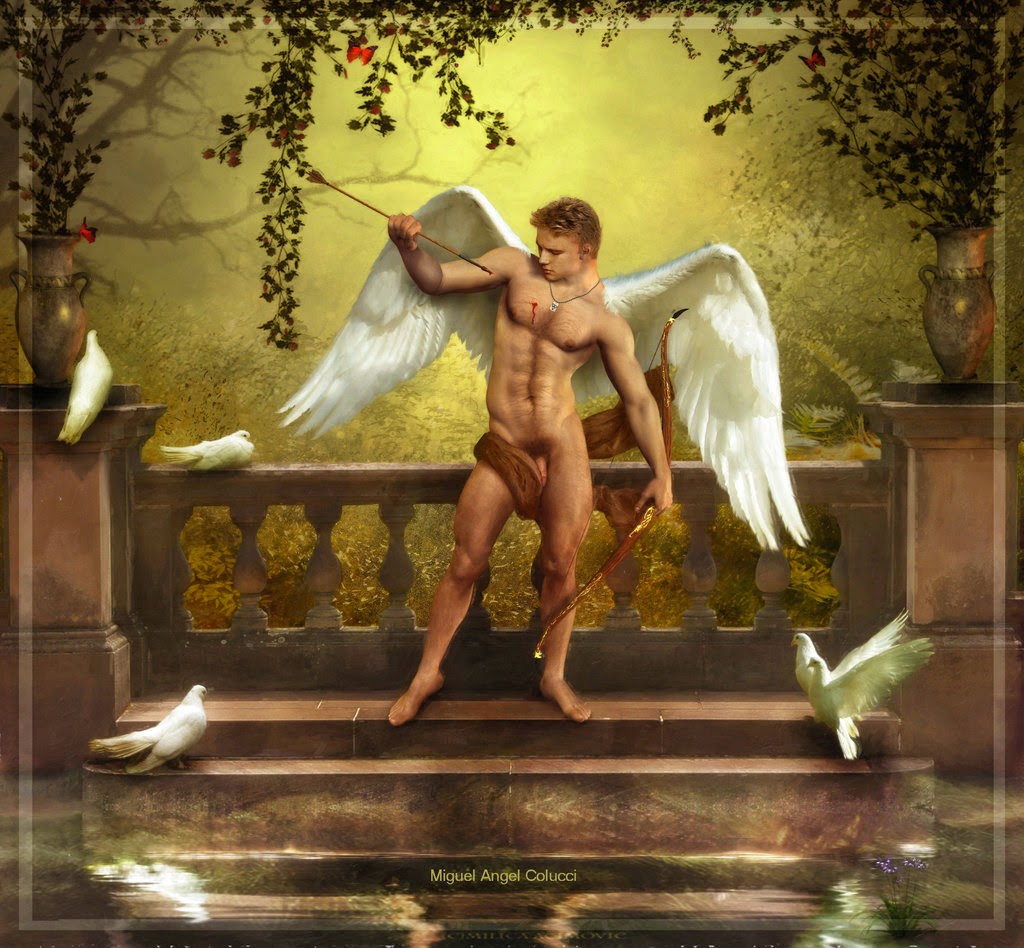
Love is in the air and so is broken heart. Eros was the Greek God of Love, or more precisely, passionate and primal sexual desire. Without warning he selects his targets and forcefully strikes at their hearts, bringing confusion and irrepressible feelings or in the words of Hesiod “ he loosens the limbs and weakens the mind” . In fact, the word erotic comes from his name. Eros himself is a carefree and beautiful youth. Personally I think he is one of the most powerful gods in existence. He makes most gods (favorite target is Zeus) fall in love/lust with other gods and/or mortals regardless of gender.  It was thought that Eros’ arrows, often randomly aimed, made people fall in love. One of the most famous tells involving this was when Apollo ridiculed the skills of Eros as an archer. Apparently Apollo forget he was talking to the son of Aphrodite and ARES. As payback for the remark Eros fired one of his arrows at Apollo, making him fall in love with the nymph Daphne and curs...

Creation Story: Greek Version part II

Image
The First Titanomachy Hades was very skilled in navigating under the earth, was able to lead them all into Tartarus (through a network of Underworld tunnels). There, imprisoned in the maximum-security zone, surrounded by huge bronze walls, and a lava moat, guarded fierce demons, were the Elder Cyclopes and Hekatonkheires. Their guardian, Kampê, was the most ferocious and fearsome monster in all of Tartarus, and even Poseidon, Hades, and Zeus initially shuddered with horror when they saw the infernal monster for the first time. However, the gods overcame their fear, and were able to sneak in. Zeus managed to talk to the Cyclopes Brontes, and convinced him to forge powerful weapons for him and his siblings behind Kampê's back. The three Elder Cyclopes forged three incredibly powerful weapons: the Master Bolt (for Zeus), the Trident (for Poseidon), and the Helm of Darkness (for Hades). With these new weapons, Zeus destroyed Kampê, and Poseidon shattered the chains of the Elder Cy...