Posts

Showing posts with the label Greek History

Dog Days of Summer

Image
The Dog Days are traditionally the 40 days leading up to the heliacal rising of Sirius, being the period of  3 rd  July to 11 th  August.   These are considered to be the hottest days of the summer – especially in the regions around the Mediterranean Sea, where Sirius has long had a major role in mythology, religion and agriculture.  For the Egyptians the rising of Sirius was essential, marking the inundation of the Nile and the start of a new year.  Sirius, which was also known as Sothis, was closely linked to the Egyptian Mother goddess Isis (Aset) and Osiris, Ruler of the Underworld.  Osiris: God King of the Underworld  Sirius has been known since ancient times, and its name signified its nature as “scorching” or “sparkling.” It was associated with the Egyptian god Osiris and other gods. Ancient Egyptians noted that Sirius rose just before the sun each year immediately prior to the annual flooding of the Nile River. Although...

History of Dildoes

Image
A dildo is a sex toy, often explicitly phallic in appearance, intended for sexual penetration or other sexual activity during masturbation or with sex partners. Some expand this definition to include vibrators. Others exclude penis prosthetic aids, which are known as "extensions". Some include penis-shaped items clearly designed with vaginal penetration in mind, even if they are not true approximations of a penis. Some people include devices designed for anal penetration (butt plugs), while others do not. These devices are often used by people of all genders and sexual orientations, for masturbation or for other sexual activity. Conventionally, many dildos are shaped like a human penis with varying degrees of detail; others are made to resemble the phallus of male animals. Not all, however, are fashioned to reproduce the male anatomy meticulously, and dildos come in a wide variety of shapes. These may resemble figures, or simply be practical creations which stimulate ...

Seven Wonders of the World: Colossus of Rhodes

Image
Travelers to the New York City harbor see a marvelous sight. Standing on a small island in the harbor is an immense statue of a robed woman, holding a book and lifting a torch to the sky. It is sometimes referred to as the "Modern Colossus," but more often called the Statue of Liberty. This awe-inspiring statue was a gift from France to America and is easily recognized by people around the world. What many visitors to this shrine to freedom don't know is that the statue, the "Modern Colossus," is the echo of another statue, the original colossus, which stood over two thousand years ago at the entrance to another busy harbor on the Island of Rhodes. In the late 4th century BC, Rhodes, allied with Ptolemy I of Egypt, prevented a massive invasion staged by their common enemy, Antigonus I Monophthalmus and his son Demetrius. In 304 BC a relief force of ships sent by Ptolemy arrived, and Antigonus's army abandoned the siege, leaving most of their siege equi...

Seven Wonders of the Ancient World: Temple of Artemis

Image
The temple of Artemis is known as one of the Seven Wonders of the ancient world. It has been built in the areas of Ephesus on a flat area which has over the centuries turned into a swamp. If you visit Ephesus today, you can only see the ruins of the foundations of this marvelous construction of the Hellenistic Age, entirely made of marble and full of sculptured columns' capitals and shafts. The most beautiful remaining of this temple is today exhibited in the London British Museum. The Temple of Artemis was located near the ancient city of Ephesus, about 75 km south from the modern port city of İzmir, in Turkey. Today the site lies on the edge of the modern town of Selcuk. The sacred site at Ephesus was far older than the Artemision itself. Pausanias was certain that it antedated the Ionic immigration by many years, being older even than the oracular shrine of Apollo at Didyma. He said that the pre-Ionic inhabitants of the city were Leleges and Lydians. Callimachus, in his Hym...

Seven Wonder of the Ancient World: Statue of Zeus Edition

Image
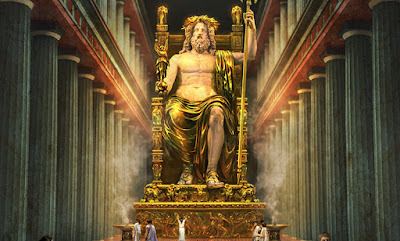
In the ancient world, there were many temples dedicated to Zeus, God of Gods and the King of the Gods. But there was only one temple to Zeus that housed one of the seven wonders of the ancient world. The Temple of Zeus at Olympia was home to one of greatest sculptural achievements of ancient history. The Statue of Zeus at Olympia represented the pinnacle of Classical sculptural design. A sculpture of ivory plates and gold panels over a wooden framework, it represented the god Zeus sitting on an elaborate cedar wood throne ornamented with ebony, ivory, gold and precious stones. No copy of the statue has ever been found, and details of its form are known only from ancient Greek descriptions and representations on coins. The great seated statue as fashioned by Phidias occupied half the width of the aisle of the temple built to house it. The city-state of Olympia was a center of religious worship, and was also the birthplace of the Olympic Games. Believed to have begun in 776 BC, th...

Warrior's pick: the Spartans

Image
Sparta was one of the most efficient and strongest of the Leading Greek city states in its time. The Spartans were highly organized and their land based army was almost untouchable, both in its battle skills and it’s mastery of warfare tactics and fighting. Sparta is believed to have begun around the 8th century BC, growing stronger in status and power till it reached its high point around the 4th – 6th century BC. Their patron god is Ares, God of War, and with his blessing Sparta became a mighty force.  It is said that around halfway through the 6th century when Sparta had managed to position itself as one of the strongest city states in Greece. Now holding such a position the entire league would be obliged to follow Sparta’s lead into a battle if required, and in case of any uprisings or upsets; the fellow city-states would come to Sparta’s aid as they were the main dominant force The battle of Thermopylae made the 300 Sparta warriors and their sacrifice changed the course ...

By Words of the Oracle

Image
“I am the spirit of Delphi, speaker of the prophecies of Phoebus Apollo, slayer of the mighty Python. Approach speaker and ask.” Delphi in ancient Greece was the home of the most famous oracle of ancient times, at the sanctuary of Pythian Apollo. The Oracle of Delphi is Pythia who was a powerful priestess at the Temple of Apollo. People would come from all over to ask the Oracle for her wisdom and the words of Apollo about important matters of public policy to personal affairs. The Oracle would also be consulted before any kind of important decision, including war or the founding of colonies. Priests and priestesses at an oracle spoke on behalf of the gods. The advice from the gods usually so vague that it always seemed to be right. The spirit of the Oracle of Delphi was passed on from maiden to maiden to continue to speak the prophecies of Apollo. People from all over Mediterranean World as far as Lydia, Caria, Rome, and even Egypt would send a representative to consult the O...

Seven Deathly Sin: Wrath Second Edition

Image
To recap: Wrath (Latin, ira), also known as "rage", may be described as excessive and uncontrolled feelings of hatred and anger. Wrath, in its purest form, presents with self-destructiveness, violence, and hate that may provoke feuds that can go on for centuries. Wrath may persist long after the person who did another a grievous wrong is dead. Feelings of anger can manifest in different ways, including impatience, vigilantism, and revenge. Accounts of the murder often speculate on the possible complicity of Philip of Macedon's wife, the fierce Olympias, and his half-estranged son, Alexander. The full story is less well known, but it is given in circumstantial detail by Diodorus Siculus and confirmed by Aristotle. The polygamous Philip, who 'waged war by marrying’, had several wives and numerous mistresses, but he also had male favorites. One of these, Pausanias ('beloved by him for his beauty') though the relationship is often stormy. Though Philip ...