Posts

Showing posts with the label Christianity

Happy Mardi Gras

Image
Mardi Gras is a Christian holiday and popular cultural phenomenon that dates back thousands of years to pagan spring and fertility rites. Also known as Carnival or Carnaval, it’s celebrated in many countries around the world—mainly those with large Roman Catholic populations—on the day before the religious season of Lent begin. Brazil, Venice and New Orleans play host to some of the holiday’s most famous public festivities, drawing thousands of tourists and revelers every year. Lupercalia Mardi Gras is a tradition that dates back thousands of years to pagan celebrations of spring and fertility, including the raucous Roman festival of Lupercalia. When Christianity arrived in Rome, religious leaders decided to incorporate these popular local traditions into the new faith, an easier task than abolishing them altogether and making popular among the locals. As a result, the excess and debauchery of the Mardi Gras season became a prelude to Lent, the 40 days of fasting and penance...
Happy Patrick's Day

Image
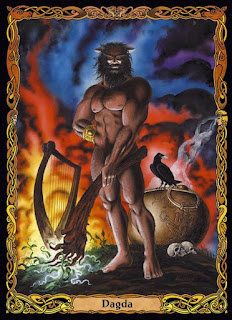
Some of the Popular Myths and Legends of Ireland The Harp of the Dagda This story concerns the most ancient Irish Celtic gods, the first generation of the Tuatha Dé Danaan who had to fight off the giant races of the Firbolgs and the Formorians. Their history is found in the  Lebor Gabála , ‘The Book of Invasions’. When the fairy race of the Tuatha Dé Danann arrived in Ireland, they came like a mist across the waters, bringing with them magical gifts. These were the  Lia fail  – the coronation stone, the spear of Lugh, the sword of Nuada, and the great cauldron of the Dagda, which was said to be able to restore life. The Dagda himself was known as the Good God and he was chief of the gods at this time. Besides his cauldron, he had a harp which was battle-scarred and made of oak. It was covered in rich decorations including a double-headed fish which ran up and down the curved pillar and had jewels for its eyes. Although he had a harper, Uaithne, he cou...

Origins of Easter

Image
Easter, the principal festival of the Christian church year, celebrates the Resurrection of Jesus Christ on the third day after his Crucifixion. The origins of Easter date to the beginnings of Christianity, and it is probably the oldest Christian observance after the Sabbath (observed on Saturday). Later, the Sabbath subsequently came to be regarded as the weekly celebration of the Resurrection. Meanwhile, many of the cultural historians find, in the celebration of Easter, a convergence of the three traditions - Pagan, Hebrew and Christian. The origins of the word "Easter" are not certain. The name "Easter" originated with the names of an ancient Goddess and God. The Venerable Bede, (672-735 CE), a Christian scholar, first asserted in his book De Ratione Temporum that Easter was named after Eostre (a.k.a. Eastre). She was the Great Mother Goddess of the Saxon people in Northern Europe. Similarly, the "Teutonic dawn goddess of fertility [was] known vario...

Happy Birthday to the Sun

Image
Happy Birthday to the Gods of the Sun and Light Sol Sol Invictus "the Unconquered Sun" is the name of a Roman sun (sol) god popular from at least the 3rd century. Before Sol Invictus came to prominence, the Romans already had a sun god, Sol Indiges, who had been worshiped since the period of the Roman Republic. (The meaning of "Indiges" is debated. Sol Indiges could mean the indigenous sun.) The Emperor Nero had built a colossal statue associated with a sun god Sol. Sol Invictus may have been an import from the East. The Roman emperor Elagabalus worshiped a Syrian sun god, but it is Emperor Aurelian who is particularly associated with the Invictus because he, having attributed to the god his victory over the Palmyrenes, set up a temple to Sol Invictus in the Campus Martius, established a priesthood for the god, and created games in his honor (ludi solis), in 274. Aurelian tried to establish Sol Invictus as supreme god of the Romans, particularly among the ...

Seven Wonders of the Ancient World: Temple of Artemis

Image
The temple of Artemis is known as one of the Seven Wonders of the ancient world. It has been built in the areas of Ephesus on a flat area which has over the centuries turned into a swamp. If you visit Ephesus today, you can only see the ruins of the foundations of this marvelous construction of the Hellenistic Age, entirely made of marble and full of sculptured columns' capitals and shafts. The most beautiful remaining of this temple is today exhibited in the London British Museum. The Temple of Artemis was located near the ancient city of Ephesus, about 75 km south from the modern port city of İzmir, in Turkey. Today the site lies on the edge of the modern town of Selcuk. The sacred site at Ephesus was far older than the Artemision itself. Pausanias was certain that it antedated the Ionic immigration by many years, being older even than the oracular shrine of Apollo at Didyma. He said that the pre-Ionic inhabitants of the city were Leleges and Lydians. Callimachus, in his Hym...

Happy St. Patrick's Day

Image

In the Beginning: Genesis Edition

Image
This month is about creation so I am starting with the best known creation story: Genesis. Genesis: in its first three chapters have a major impact on Judaism and Christianity through the ages. It show man fall from grace, the role of women, and reveal we have conflict and death today. If you read carefully you can see how old genesis and the echo of ancient pagan roots. In the beginning, about 3,000 years ago*, Jewish desert dwellers in what is present-day southern Israel told a story around campfires about the creation of the first man and first woman.  The story they told, and passed on to generations of future desert dwellers, described a pre-creation scene much like the desert landscape in which they daily struggled for existence.  From the dry desert dust the Creator forms a man and breaths life into him, and then places him in a beautiful oasis-like garden, abundant with fruits.  The Creator takes a personal interest in this first man, and sets about trying to ...

Happy St. Patrick Day

Image
It’s that time of year again, the time when people start drinking green beer, wearing green clothes, and loving all things Irish, the time when leprechauns come to the forefront of our thoughts. Leprechauns are the wee men folk of the fairy world. A lot of superstition and stereotyping happens around leprechauns. And though we know of them, very well (I mean, everyone knows what a leprechaun is!), there simply are not very many stories about leprechauns. Sure, there are lots of modern stories, particularly children’s stories, but not a whole lot in the realm of folklore. Generally, the leprechaun is mentioned in a story but doesn’t have an entire fairy tale or story about him. Origins The origins of leprechauns are very strange. Leprechauns are usually considered to be a small earth dwelling fairy. They originated, most people think, in Ireland. They were called Cluricaunes, luricanes, lurikeens, and lubberkins. They were not called leprechauns until late seventeenth centur...