Posts

Showing posts with the label Norse Mythology

Happy Valentine's Day

Image
Popular Gods and Goddesses of Love from around the world Inanna was the oldest of the love goddess of the Mesopotamian region. She was a Sumerian goddess of love and war. Although she is regarded as a virgin, Inanna is a goddess responsible for sexual love, procreation, and fertility. Hathor (Het-Heru) , meaning "House of Horus the Elder", was a goddess of many things, from the celestial to the alcoholic!  Hathor is one of the most beloved of Egypt's goddesses, a benevolent, understanding and stunningly beautiful figure responsible for all artistic endeavor and happiness in the world. Hathor brings happiness, romance and an appreciation for musical arts into our lives. Hathor was worshipped by both men and women in ancient Egypt. She presides over festivals whose sole purpose is to bring joy to the participants. Devotees of the Goddess were mostly dancers, musicians, and artisans. Dance and music were the sacred arts of Hathor and Hathor was thought to be th...

Roll call of the War Gods

Image
War and strife have never been far from human society. For the ancients, war was a way of life, and its varied expressions and nuances determined a host of patron deities. There’s a misconception among many that functions of gods and goddesses were attributed to a single aspect or purpose. It is true that Gods and Goddesses were known for specific roles that involved their skills, but what's blown out of proportion are stories about a single purpose deity not connecting with other aspects of warfare. Gods and Goddesses have been associated with a specific order for their expertise at a particular craft. This article showcases a list of some of the most powerful Gods and Goddesses of war from world mythology. I invoke these gods to combat Trump's presidency in near future and protect the average citizens from his regime of madness. Athena is the Greek Goddess of Wisdom and Warfare. Her warfare was the tactical warfare that calculated each move carefully with strategic st...

The Guide of the Afterlife

Image
Psychopomps Psychopomps (from the Greek word psuchopompos, literally meaning the "guide of souls") are creatures, spirits, angels, or deities in many religions whose responsibility is to escort newly deceased souls from Earth to the afterlife. Their role is not to judge the deceased, but simply to provide safe passage. Appearing frequently on funerary art, psychopomps have been depicted at different times and in different cultures. Anubis is the jackal-headed god of ancient Egypt, who presides over the purification and mummification of the body and is well known for his role as a psychopomp. At the time of death he leads the ba (the aspect of a person that is activated in non-ordinary states, such as sleep and death) to the entrance to the underworld, where the ba undergoes its own purifying journey. After this, Anubis reunites the person’s ba with their core self (or heart) and then leads the deceased to the Hall of Maat where the scales of judgment weigh the heart...

Beware the Tricks of Loki

Image
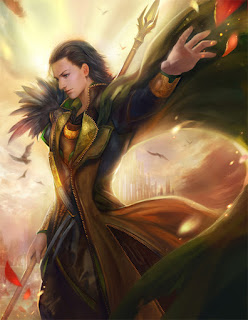
God of Mischief, Chaos and Change Master of Magic and adept Shapeshifter  Harbinger of Ragnarok and Rebirth of the Worlds What is it about Loki that has made him so very popular within Western culture when we want to be entertained by a troublemaker within our books and movies? Of all of the gods from the various pantheons that are out there, he seems to be one that has captured people’s imagination the most, and it started before Tom Hiddleston played him in Thor and The Avengers. Possibly it has a little bit to do with the fact that he is someone who is so closely associated with mischief and causing trouble. There are other figures that perform that function as well (like Puck, Anansi, or Coyote), but none of them seem to have latched onto our collective consciousness the same way that Loki has. But there also may be a bit of the fact that he is able to help people get out of trouble as well (though, he’s usually helping them get out of whatever sticky situation that he...

The Dead is Rising: Beware of the Draugar

Image
Draugar (being plural of draug) possess superhuman strength, can increase their size at will, and carry the unmistakable stench of decay. "The appearance of a draugr was that of a dead body: swollen, blackened and generally hideous to look at." They are undead figures from Norse and Icelandic mythology that appear to retain some semblance of intelligence. They exist to guard their treasure, wreak havoc on living beings, or torment those who had wronged them in life. The draugr's ability to increase its size also increased its weight, and the body of the draugr was described as being extremely heavy. While land-draugar was simply undead with numerous magical abilities, sea-draugar was fishermen who had drowned at sea, thus being denied the privilege of being buried. Draugar are depicted as having either pitch black or pale white skin. Draugar are noted for having numerous magical abilities, such as shape-shifting, controlling the weather, and seeing into the futu...

The Dead is rising

Image
As the veils between the world of the living and the dead weaken around this time. Let's remember the monsters and ghouls that scare the crap out of us and the heroes who conquer them.    In Norse religion the einherjar were spirits of warriors who had died bravely in battle. The name is Old Norse for "one-army-ers" (singular would be einheri). It is often interpreted as "outstanding fighter", but might also signify "those who are all in one army", because when alive on earth they were in many armies and bands, but now they are all in the Army of Asgard. Einherjar warriors are personally trained by the ruler of Asgard and are tasked with protecting Asgard. After they die, the Valkyries escort half of the slain from the battlefield to Valhalla (these are the "einherjar"), which is part of Asgard (commonly described as the "Norse Heaven"); the other half went to Fólkvangr (Freyja's hall). The Grímnismál describes Valhall...

Beach Day with Njord

Image
hj Njord or Njordr (Old Norse Njörðr) is one of the Vanir and the god of wind, fertile land along the seacoast, as well as seamanship, sailing and fishing, he has the power to calm the sea or fire. Njord is the god of the wind and of the sea and its riches. He was married to Skadi, a Giantess. The marriage failed because Njord preferred to live by the sea, while Skadi was happier in her father’s mountain dwelling place. He was the father of Freyr and Freyja by his own sister, Nerthus, who was his first wife. Their mother was Njord's own sister and lover. Apparently the Vanir, unlike the Æsir, had the custom of marriage of your sibling. His dwelling is said to be Noatún ('Ship-town'). There were two main clans of gods, the Aesir as lead by Odin, and the Vanir, lead by Njord. Njord and his kin were recognized as the gods of agriculture and fertility, whilst the Aesir were known to be the gods of warfare and of power. With two distinct areas of worship, Njord was conside...