Posts

Origins of Easter

Image
Easter, the principal festival of the Christian church year, celebrates the Resurrection of Jesus Christ on the third day after his Crucifixion. The origins of Easter date to the beginnings of Christianity, and it is probably the oldest Christian observance after the Sabbath (observed on Saturday). Later, the Sabbath subsequently came to be regarded as the weekly celebration of the Resurrection. Meanwhile, many of the cultural historians find, in the celebration of Easter, a convergence of the three traditions - Pagan, Hebrew and Christian. The origins of the word "Easter" are not certain. The name "Easter" originated with the names of an ancient Goddess and God. The Venerable Bede, (672-735 CE), a Christian scholar, first asserted in his book De Ratione Temporum that Easter was named after Eostre (a.k.a. Eastre). She was the Great Mother Goddess of the Saxon people in Northern Europe. Similarly, the "Teutonic dawn goddess of fertility [was] known vario...

Bring in the Season of New Life with Cernunnos

Image
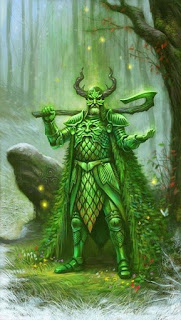
At the dawn of prehistory, it is said, humanity worshiped a Goddess who often co-existed with a male Deity, sometimes depicted with horns. Such figures represent humanity's elemental search for survival and meaning in mortality, a relentless quest for unity with the divine and the interdependent nature of the existential web. Cernunnos is a horned god found in Celtic mythology. He is connected with male animals, particularly the stag in rut, and this has led him to be associated with fertility and vegetation. Depictions of Cernunnos are found in many parts of the British Isles and Western Europe. He is often portrayed with a beard and wild, shaggy hair -- he is, after all, the lord of the forest. With his mighty antlers, Cernunnos is a protector of the forest and master of the hunt. He is a god of vegetation and trees in his aspect as the Green Man, and a god of lust and fertility when connected with Pan, the Greek satyr God of the Wild. In some traditions, he is seen as a god...

What the future awaits?

Image
I call the Most Powerful Goddesses of the Greek pantheon: The Fates The Moirai (Fates) controlled the mother thread of lifestyle of every mortal from birth to death. They were independent, at the helm of necessity, directed fate, and watched that the fate assigned to every being by eternal laws might take its course without obstruction. The gods and men had to submit to them, although Zeus's relationship with them is a matter of debate: some sources say he is the only one who can command them (the Zeus Moiragetes), yet others suggest he was also bound to the Moirai's dictates. They assigned to the Erinyes, who inflicted the punishment for evil deeds, their proper functions; and with them they directed fate according to the laws of necessity. Invisible bonds and knots could be controlled from a loom, and twining was a magic art used by the magicians to harm a person, and control his individual fate. Similar ideas appear in Norse mythology, and in Roman legends. The appeara...

Sir Gawain and the Green Knight

Image
The story begins at Christmastime at King Arthur’s court in Camelot. The Knights of the Round Table join Arthur in the holiday celebrations, and Queen Guinevere presides in their midst. The lords and ladies of Camelot have been feasting for fifteen days, and now it is New Year’s Day. Everyone participates in New Year’s games, exchanging gifts and kisses. When the evening’s feast is about to be served, Arthur introduces a new game: he refuses to eat his dinner until he has heard a marvelous story. Be careful for you wish for. While the lords and ladies feast, with Arthur’s nephew Gawain and Guinevere sitting together in the place of privilege at the high table, Arthur continues to wait for his marvel. As if in answer to Arthur’s request, an unknown knight suddenly enters the hall on horseback. The gigantic knight has a beautiful face and figure. Every piece of his elaborate armor is green, with flourishes of gold embossing. His huge horse is green, and his green hair and beard are...

Merry Christmas

Image

Happy Birthday to the Sun

Image
Happy Birthday to the Gods of the Sun and Light Sol Sol Invictus "the Unconquered Sun" is the name of a Roman sun (sol) god popular from at least the 3rd century. Before Sol Invictus came to prominence, the Romans already had a sun god, Sol Indiges, who had been worshiped since the period of the Roman Republic. (The meaning of "Indiges" is debated. Sol Indiges could mean the indigenous sun.) The Emperor Nero had built a colossal statue associated with a sun god Sol. Sol Invictus may have been an import from the East. The Roman emperor Elagabalus worshiped a Syrian sun god, but it is Emperor Aurelian who is particularly associated with the Invictus because he, having attributed to the god his victory over the Palmyrenes, set up a temple to Sol Invictus in the Campus Martius, established a priesthood for the god, and created games in his honor (ludi solis), in 274. Aurelian tried to establish Sol Invictus as supreme god of the Romans, particularly among the ...

Beware of Krampus

Image
Krampus is the devilish child punishing companion of St. Nicholas. On December 6th, Nicholas brings joy and presents to good children throughout Austria, Germany, Hungary, Slovakia, and the Czech Republic. The kindly old Saint leaves the task of punishing bad children to a hell-bound counterpart The Horned Devil, also known as Krampus known by many names across the continent — Knecht Ruprecht, Certa, Perchten, Black Peter, Schmutzli, Pelznickel, Klaubauf, and Krampus. The evening before, “Krampusnacht”, the children are visited by the Krampus, St. Nicholas’s “bad cop” partner, a devil who rises from hell to torment bad children. Krampus is usually portrayed as a classic red devil figure with fur, cloven hooves, horns and a long snake like tongue. He often carries instruments of punishment, sticks and chains to whip naughty children and a large backpack like wicker basket that is used to imprison children and transport them to hell. Although normally devilish, Krampus has taken ...